
Understanding the Vulnerability of Healthcare Critical Infrastructure Nexus
How can hospitals continue delivering healthcare services during extreme weather events? Researchers in the Resilient Futures Lab have been modeling the healthcare critical infrastructure nexus under flooding to support resilience planning.
Hospitals are essential to community safety during natural disasters. Yet their ability to provide care depends on much more than the hospital building itself. Power systems, water and wastewater services, transportation networks, communications, and other critical infrastructure must continue functioning for healthcare facilities to remain operational.
CURA and SimTigrate Affiliated faculty Dr. Yiyi He and Ph.D. student Yuhan Xu, in collaboration with Dr. Hui Cai from the School of Architecture, Director of the SimTigrate Design Center, are developing a modeling framework to better understand these interconnected systems, referred to as the healthcare critical infrastructure (HCI) nexus. The project investigates how hurricane-induced flooding can trigger cascading disruptions across external critical infrastructure (CI) systems and, in turn, affect healthcare facilities' ability to deliver care.
The hidden web of dependencies
Many existing studies assess the structural condition of hospital buildings or the performance of systems located within a facility. However, a hospital may remain structurally intact while still losing important functions because of failures outside the building.
Our work initially focuses on Lee Health system in Lee County, Florida, a region that faces substantial risks from hurricanes. In September 2022, when Hurricane Ian made landfall in Southwest Florida, Lee Health system experienced unprecedented disruptions caused by compound flooding. Damage to municipal water infrastructure and sanitary sewers triggered cascading failures across interconnected systems. These disruptions forced Lee Health to divert critical staff and resources from patient care to emergency system maintenance, exposing the acute vulnerability of the HCI nexus to hurricane-induced flooding.
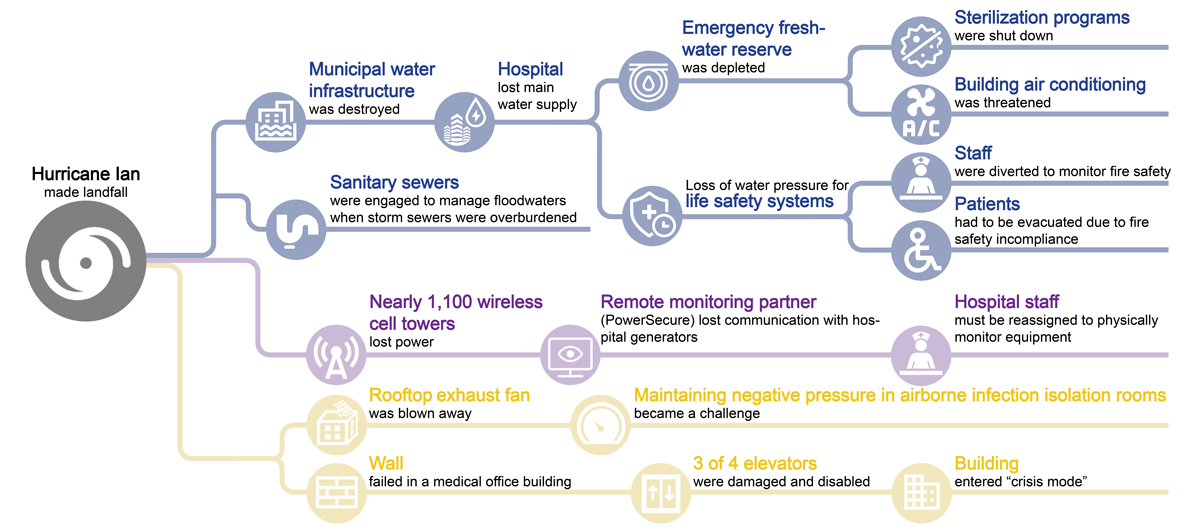
These experiences demonstrate that hospital resilience cannot be understood by examining healthcare facilities in isolation. By identifying the interdependencies between hospitals and the infrastructure systems that support them, our project seeks to answer two fundamental questions: What does the HCI nexus look like, and how can it be modeled to simulate evolving failure probabilities during an extreme event?
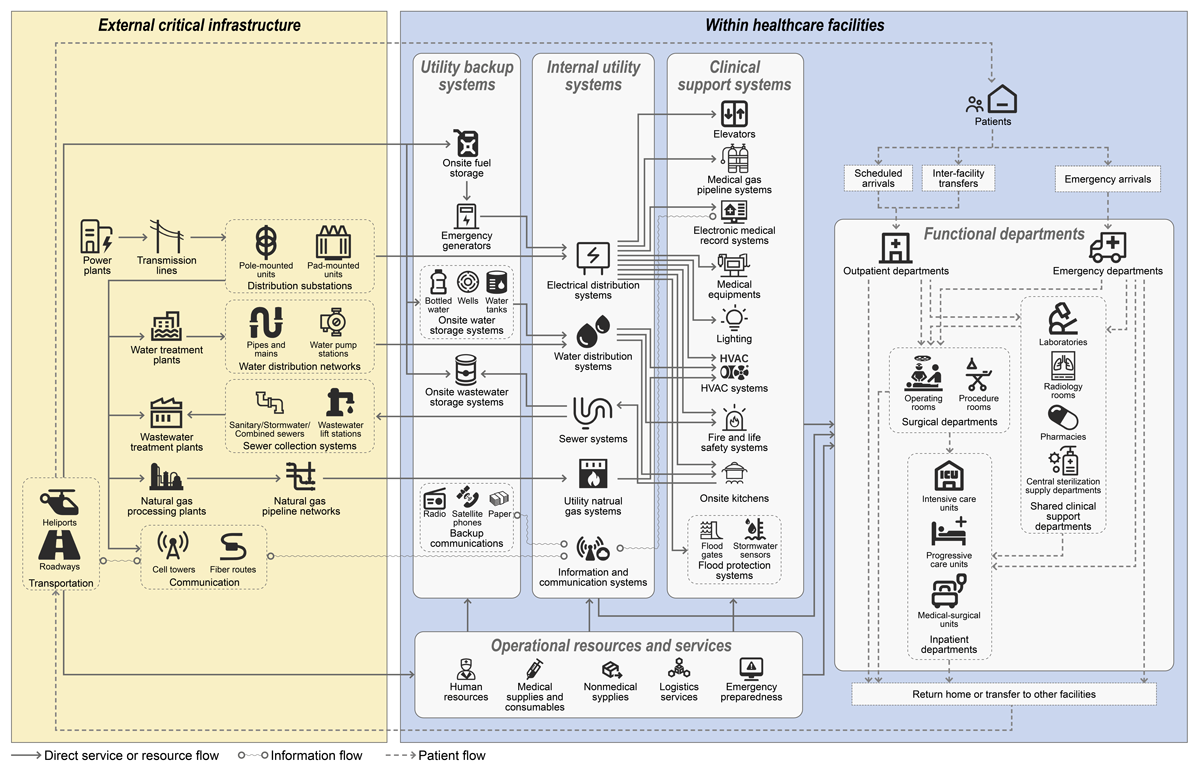
Conceptual representation of the HCI nexus
The HCI nexus is conceptualized as an interdependent network that enables the safe and continuous delivery of healthcare services. External CI systems provide essential lifeline services, including electricity, water, wastewater management, communication, and transportation access. Within healthcare facilities, internal utility systems distribute and regulate these technical inputs; operational capabilities mobilize personnel, supplies, equipment, and emergency management resources; and functional departments convert these resources into clinical services for patients.
Developing an integrated modeling framework
Building on this conceptual representation, we are developing an integrated modeling framework that combines Fault Tree Analysis (FTA) with a Dynamic Bayesian Network (DBN) to assess hospital functionality and resilience under hurricane-induced disruptions. First, FTA is used to identify critical basic and intermediate events and map the logical relationships through which disruptions to external CI, internal utility systems, and clinical support systems can lead to the loss or degradation of key hospital functions, particularly those of the Emergency Department (ED) and Intensive Care Unit (ICU). These fault tree structures provide the basis for developing a DBN that probabilistically represents interdependencies, cascading failures, and the evolution of hospital functionality over time.
Using HealthPark Medical Center as a case, our model estimates the probability that different components of the HCI nexus remain functional, operate at reduced capacity, or fail under different hazard scenarios. The model can then identify critical dependencies, examine potential cascading failure chains, and evaluate strategies such as infrastructure protection, backup systems, redundancy, resource prioritization, and improved coordination among healthcare providers and infrastructure agencies.
In the long term, our study aims to establish a transferable, data-driven framework that links infrastructure resilience with public health outcomes across diverse communities and multiple climate change scenarios. The case study will lay the foundation for a statewide—or even national—resilience toolkit to help healthcare facilities, urban planners, and local governments anticipate, mitigate, and recover from failures within the HCI nexus.
Learn more about the research projects of the Resilient Futures Lab and the SimTigrate Design Center. This work was presented at the 2026 American Association of Geographers (AAG) Annual Meeting and will also be presented at the upcoming 2026 Association of Collegiate Schools of Planning (ACSP) Annual Conference.
Special thanks to our partners at Lee Health
We extend our sincere gratitude to Dave Kistel, Brian M. Bradley, Rod Allen, and Wanda Short from Lee Health for their valuable collaboration and continued support. Their expertise, operational insights, and thoughtful feedback have been instrumental in advancing our research. We look forward to continuing this collaboration to strengthen healthcare resilience against future disasters.