
Examining the Challenges to the 15-Minute City
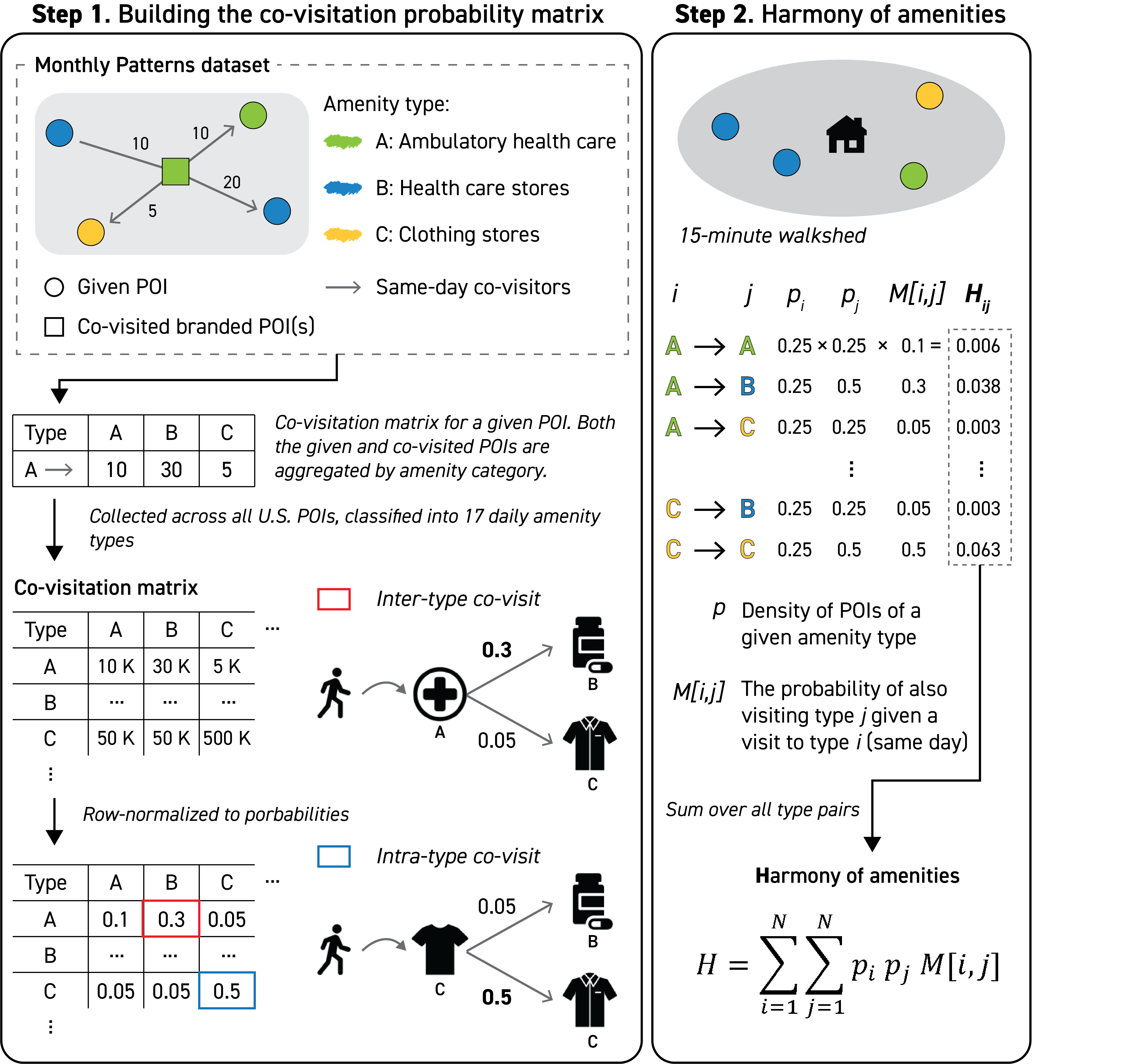
The 15-minute city promotes proximity to essential services as a pathway to walkable, localized lifestyles. Yet proximity alone may not translate into local walking. Even in highly accessible neighborhoods, residents may still drive or travel beyond their immediate area. Using home-based non-work trips from high-accessibility neighborhoods in Chicago, Ph.D. student Seung Jae Liu examined three sets of factors that may explain this gap: the spatial configuration of amenities, built environment characteristics, and individual and trip attributes. He introduce a new index “harmony of amenities” which captures a level of functional synergy among co-located amenities derived from observed same-day co-visitation patterns. A bivariate probit model jointly estimates destination choice (inside or outside the 15-minute walkshed) and mode choice (walking or driving).
Results show that proximity is necessary but insufficient. Greater sidewalk coverage, park accessibility, and visual enclosure, measured by the building-to-street ratio, are associated with a higher likelihood of walking to destinations within the 15-minute walkshed. Harmony of amenities is also associated with more localized, walkable travel, whereas conventional measures of amenity diversity and clustering are not significant in high-accessibility neighborhoods. This implies that functional synergy becomes more important once proximity is already high. Household vehicle availability strongly increases the likelihood of driving beyond the local area, while specialized trips are also more likely to extend beyond the walkshed. These findings suggest that realizing the 15-minute city requires more than increasing the number of nearby amenities. It also requires pedestrian-supportive urban design, functionally compatible amenity configurations, and attention to the behavioral factors that shape everyday travel.
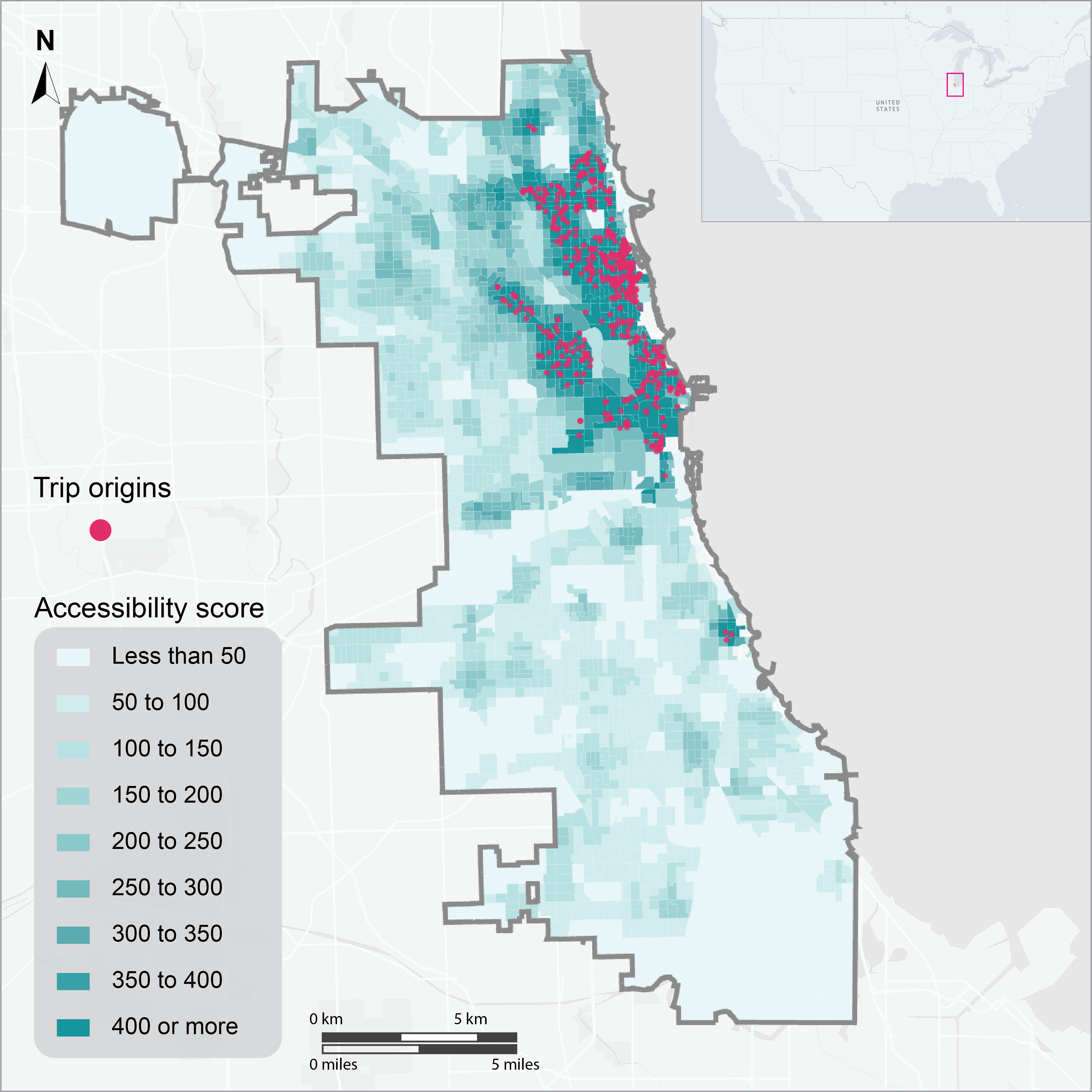
Figure 1. Accessibility scores by census block groups in Chicago, with trip origins of the analytical sample
Read the full article (https://doi.org/10.1016/j.scs.2026.107597) for more details.