
How Do We Manage Critical Heat Events?
As climate change continues to elevate the intensity of extreme heat events, the US population is increasingly vulnerable to combinations of heat and humidity exceeding the limits of human tolerance.
Recent physiological studies have found the threshold temperature for adverse health impacts – measured as the wet bulb temperature (a combination of heat and humidity) – to be lower than previously established. For a healthy young adult, a wet bulb temperature of 87°F, equivalent to 100°F with 60% relative humidity, is found to induce a fever within 60-90 minutes of exposure at a moderate activity level within warm and humid climates. For hot and arid cities of the US Southwest, wet bulb temperatures in excess of 80°F have been found to overwhelm the capacity of the human body to cool itself through sweating. With sustained exposures (> 3 hours) to these wet bulb temperatures, core body temperatures may exceed 104°F, elevating the risk of heat stroke.
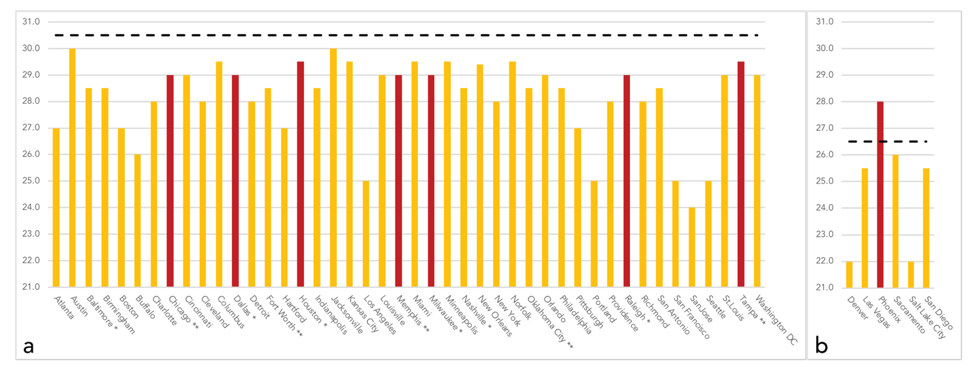
Professor Brian Stone and his team at the Urban Climate Lab are tracking wet bulb temperatures in large cities across the US to monitor this critical threshold and assist in developing plans to manage extreme humid heat events. All days with a web bulb temperature in excess of these limits (87°F in warm-humid cities such as Atlanta and 80°F in hot-arid cities such as Phoenix) are threshold heat events. Professor Stone's analysis of maximum annual wet bulb temperatures across the 50 most populous US cities finds that no major city has experienced a wet bulb temperature of 87°F over the 18 years (2006-2025) of data collected by the National Oceanic and Atmospheric Administration (NOAA), while a single city in a hot-arid climate (Phoenix) has exceeded the 80°F threshold.
Figure 1 reports the highest wet bulb temperature experienced by large US cities since 2006. Dashed horizontal lines denote the empirical critical thresholds (in Celsius) for extreme heat stress in warm-humid and hot-arid climate zones. Professor Stone's analysis finds 11 cities to have a statistically significant positive trend over this period, with seven of these cities exhibiting a maximum wet bulb temperature within 3°F of the critical threshold. A single city, Phoenix, has already exceeded this threshold. As theses thresholds are increasingly exceeded, outdoor activities such as landscaping, construction, municipal services (e.g., garbage collection), and athletic events will pose an acute health risk and should be discontinued. The Urban Climate Lab is partnering with cities in the development of urban heat management plans and climate monitoring networks to measure heat and humidity risk in real time.
For more information, please contact brian.stone@design.gatech.edu