
Fast, Accurate, and Reliable Deep Learning for Digital Twins
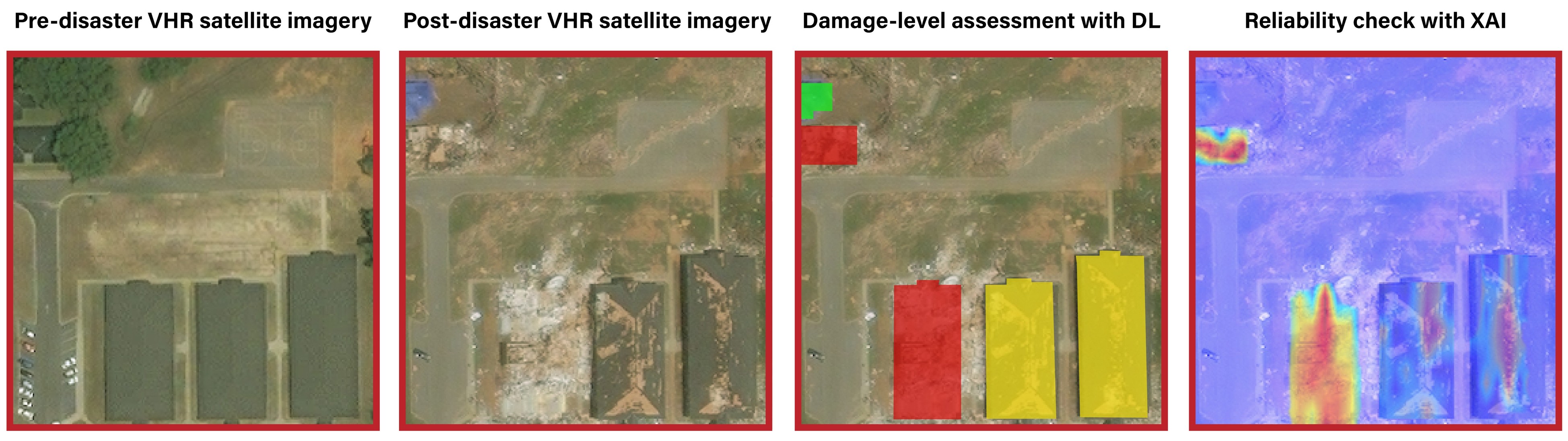
Remote sensing and deep learning (DL) are increasingly enabling rapid and large-scale post-disaster damage-level assessment from very high resolution (VHR) satellite imagery. This capability is particularly valuable in the immediate aftermath of a disaster, when timely information is essential for identifying damaged areas, prioritizing limited emergency resources, and coordinating response actions. The need for rapid and continuously updated information also makes these technologies highly relevant to digital twins, which integrate data, models, and analytics within automated and dynamically updated systems to support real-time or near-real-time decision-making. Faster damage assessment can help reduce the adverse impacts of disasters, accelerate response and recovery, and ultimately contribute to more resilient communities. However, speed and predictive accuracy alone are not sufficient. Deep learning models often operate as “black boxes,” making it difficult to determine why a particular damage level has been assigned. For these models to be confidently adopted and used by stakeholders in high-stakes disaster environments, they must therefore be not only fast and accurate, but also reliable and transparent.
CURA postdoctoral fellow Umut Lagup is developing deep learning workflows that address these requirements together. He investigate active learning to reduce the amount of manual labelling required and transfer learning to improve predictive performance while reducing data and training requirements, helping models adapt more efficiently to new disaster events and locations. At the same time, he integrated Explainable AI (XAI) as a reliability check to examine whether model predictions are driven by meaningful evidence of disaster damage rather than irrelevant features in the imagery. Such reliability checks can make model decisions more interpretable, strengthen stakeholder trust, and encourage the broader operational use of deep learning within digital twin systems. By combining efficient learning, high predictive performance, and explanation-based reliability assessment, his goal is to develop fast, accurate, and trustworthy AI-enabled digital twins that can support timely decision-making throughout post-disaster response and recovery.
For more information please contact ulagup3@design.gatech.edu