
Active Navigation with Reinforcement Learning
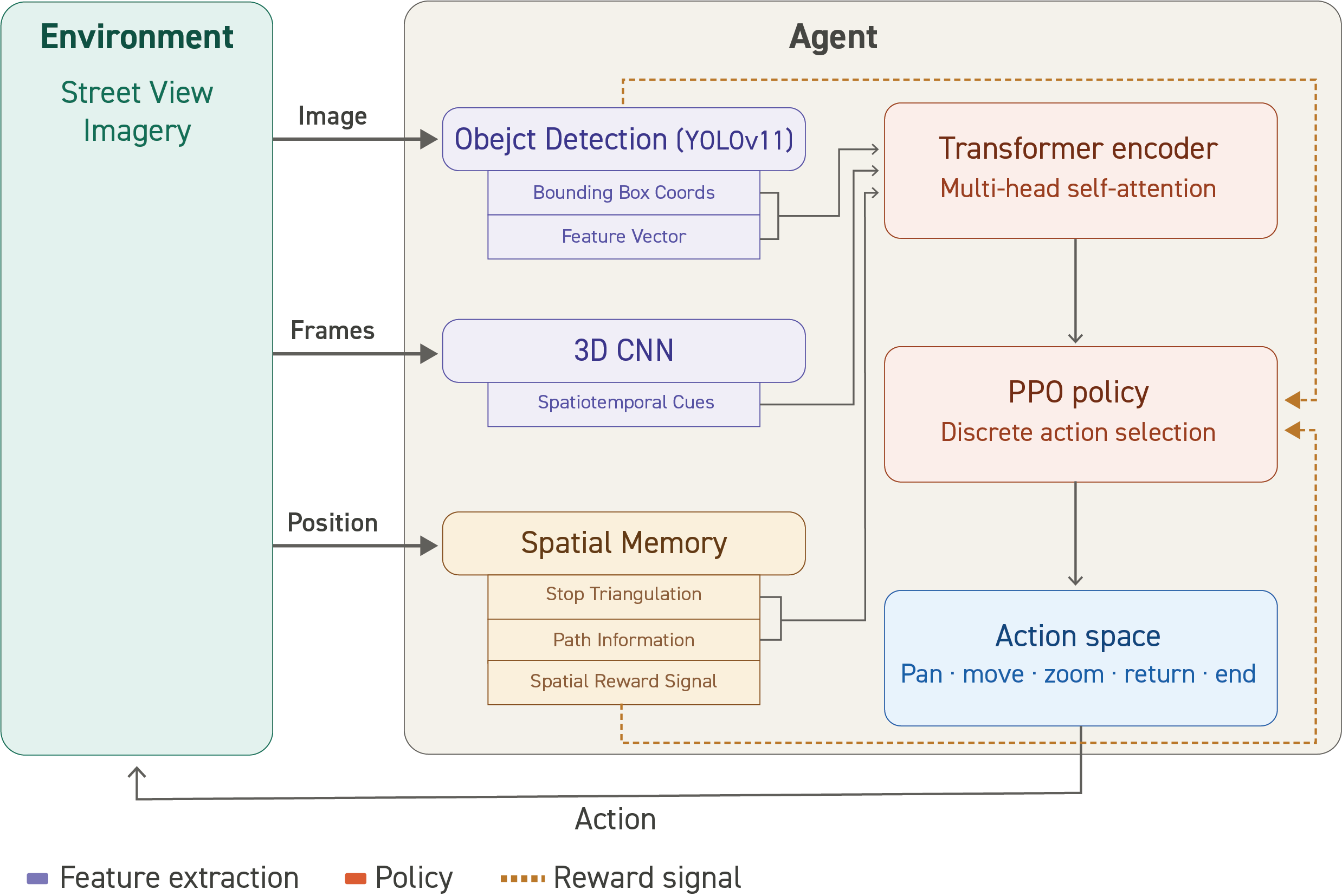
Transit agencies often lack accurate, up-to-date inventories of bus stop amenities such as signs, shelters, and seating, despite their importance for rider accessibility and service quality. Street view imagery and computer vision offer a scalable alternative to labor-intensive field surveys, but conventional approaches typically rely on images retrieved near recorded GTFS coordinates. Since these coordinates can be imprecise and amenities may be obscured by vehicles, trees, or other streetscape elements, a single viewpoint may fail to capture the stop altogether. Rule-based remedies such as fixed rotations and viewpoint shifts improve retrieval but remain limited in complex street environments.
To address these limitations, Ph.D. student Seung Jae Liu and master’s student Bryce Jones developed a reinforcement learning (RL) framework that allows an agent to actively navigate street view imagery rather than passively retrieve predetermined views. A Proximal Policy Optimization agent with a transformer-based feature extractor learns when to rotate, move, zoom, backtrack, and terminate its search, while a YOLOv11 detector provides visual features and reward signals and an external spatial memory tracks explored locations and triangulates stop positions from multiple viewpoints. Applied to 1,919 bus stops in metropolitan Atlanta, the agent located definitive stop evidence for 97% of stops on its first pass and 99% after a second pass, compared with 41.1% for static retrieval and 82.2% for the strongest staged heuristic benchmark on the same stops. It also triangulated 85% of successfully located stops from multiple viewpoints and identified bus stop amenities with higher accuracy. More broadly, the study demonstrates how active RL-based navigation can overcome a fundamental limitation of static street view retrieval and provide a scalable, repeatable approach to infrastructure auditing .
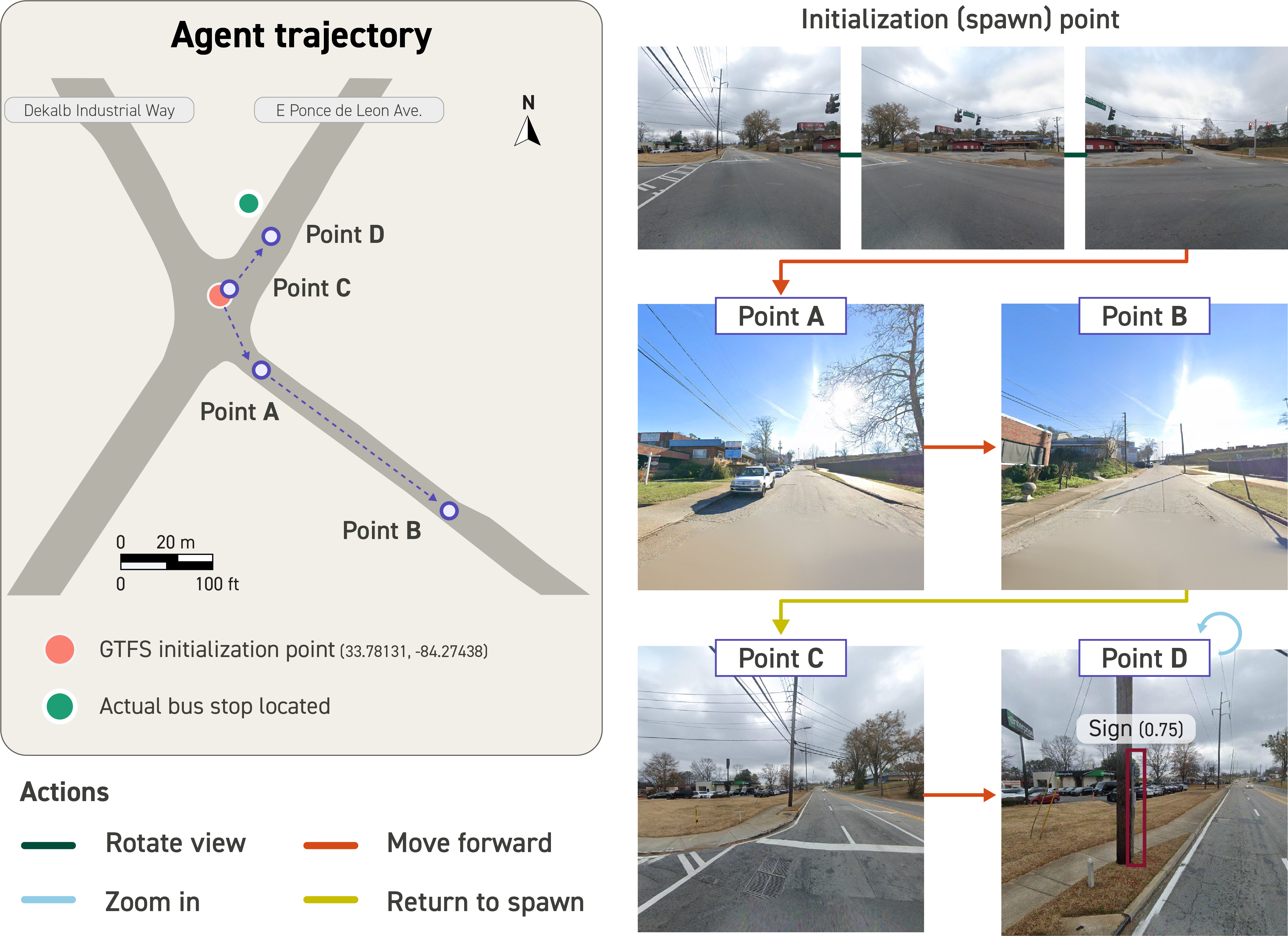
Representative example of agent navigation for a single bus stop episode
Read the full article (https://doi.org/10.1016/j.trip.2026.102240https://doi.org/10.1016/j.scs.2026.107597) for more details.